
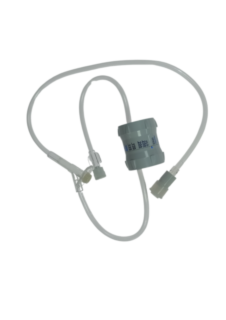
LINEAR EXTENSION PVC DEHP-FREE 3X4.1 ROTARY GRADUATED FLOW CONTROLLER Y-SITE MOBILE LUER LOCK PURGE FILTER


You are:


Rotary flow regulators have a standardized flow stability of +/- 10% over time (ISO8536-13 standard), and are therefore considered lt;precision lt; regulators. Contact us to obtain the good use sheet.
It should be noted that many factors influence flow regulation (viscosity, height, blood pressure, etc.): drop-counting and regular monitoring are therefore good practice when using these precision regulators.
Extention line with :
- High-quality tubing: flexible, anti-plication PVC
- Precision rotary flow regulator: Smooth, easy adjustment - Constant, reliable flow
- Optimum technical features: Movable Luer Lock tip, Graduations from 0 to 250 mL/h.
- Nonpyrogenic device.
Pressure resistance: 50 KPA (0.5 Bars - 7.25psi)
Dead volume: 3.08ml.
Made in China.
Graduations are indicative and reliable up to +/- 20% from 20ml/h upwards.
Thus, counting the drops in drip chamber remains mandatory to ensure that the flow follows the medical prescription.
Contact with 0.5% or 2% Chlorhexidine in 70° Isopropyl alcohol, without evaporation time, while the luer lock is connected, and therefore under physical stress, presents a significant risk of luer lock cracking, and should be avoided wherever possible.
In accordance with the recommendations of the SF2H (2019) and Didactic's disinfection protocol, it is always preferable to disinfect the connectors (when necessary) with 70° ethyl alcohol followed by a mandatory drying time of 15 secondes at least before connecting. 70° ethyl alcohol is just as effective disinfecting inert materials and then reduces the risk of altering plastic materials.
Indications
This device enables precise gravity administration of injectable parenteral preparations: drugs, solutions, parenteral nutrition.
Do not use with high-risk drugs, drugs with narrow therapeutic margins (catecholamines, morphine, heparin, insulin, potassium chloride, anticancer drugs requiring infusion pump administration, and all pharmaceutical specialties whose R.C.P. requires infusion pump or syringe pump administration or the presence of a 0.2µm filter).
Source : OMEDIT CENTRE -- Les bonnes pratiques de perfusion : Module lt; La précision du débit de perfusion lt;.
For peripheral lines, the infusion line can remain in place for a maximum of 96 hours (i.e., the maximum time the peripheral catheter can be in place).
For central lines, the infusion line must be changed at least every 72 hours (or according to the establishment's validated protocol).
Dispose of in accordance with local regulations.
Used materials
Cap: PE
Female Luer Lock: PC
Tube: PVC
Flow regulator: ABS / TPE
Luer Lock male: ABS
Cap: PE
Labeling
on each unit are written the reference, the lot/serial number, the sterilization method and the expiry date if applicable
medical device
sterile
conformity
Transport conditions
Protected from light and humidity
| Conditioning | Parts quantities | Dimensions in cm | Weight in kg | Ean 13 of conditioning |
| UNIT | 1 | 21 x 13 x 0 | 0.017 | 06972620110503 |
| BAG | 25 | 55 x 30 x 5 | 0.440 | |
| CASE | 150 | 39 x 42 x 31 | 3.520 | 16972620110500 |
| PALLET | 3000 | 120 x 80 x 173 | 88.400 |
